.svg)
TL;DR: Best Business Data APIs for SMB Lead Generation (2026)
Openmart is the only API purpose-built for local SMB data at scale, returning 200M+ verified listings with owner email and direct phone in a single call. Every other tool on this list splits between two jobs neither of which is SMB lead generation. Apollo and ZoomInfo sell enterprise B2B firmographics. Bright Data and Apify sell raw scraping infrastructure you assemble yourself.
Tool Best For SMB Focus Rate Limits Data Coverage Starting Price Openmart Local SMB + Google Maps High Millions of requests 200M+ listings, 40+ fields Credit-based Apollo.io B2B prospecting Medium Undisclosed 230M+ contacts Free tier ZoomInfo Enterprise firmographics Low Undisclosed Enterprise B2B Contact sales Bright Data Raw web scraping Low 99.99% uptime 5B+ records $0.75/1K records People Data Labs Developer enrichment Low 1,000 req/min 3B+ person records $98/month Outscraper Budget Google Maps Medium 7–25 min/task 50+ fields Free (500 records) Apify Workflow pipelines Medium No cap published 38,660+ Actors Free plan Clearbit/Breeze HubSpot enrichment Low Undisclosed CRM enrichment Bundled
Want SMB-native data without building a pipeline? Start with the Openmart Local Business API.
What Is a Business Data API?
A business data API gives you programmatic access to structured business records you can pull into your own prospecting, enrichment, and lead generation workflows. Instead of exporting CSVs by hand, you query an endpoint and get back verified contacts, firmographics, and location data in JSON.
The category splits three ways. SMB-local data APIs like Openmart return local business listings with owner contacts and Google Maps coverage. B2B firmographic APIs like ZoomInfo and Apollo.io index corporate contacts by job title and company size. Raw scraping infrastructure like Bright Data and Apify extracts unstructured web data you process yourself.
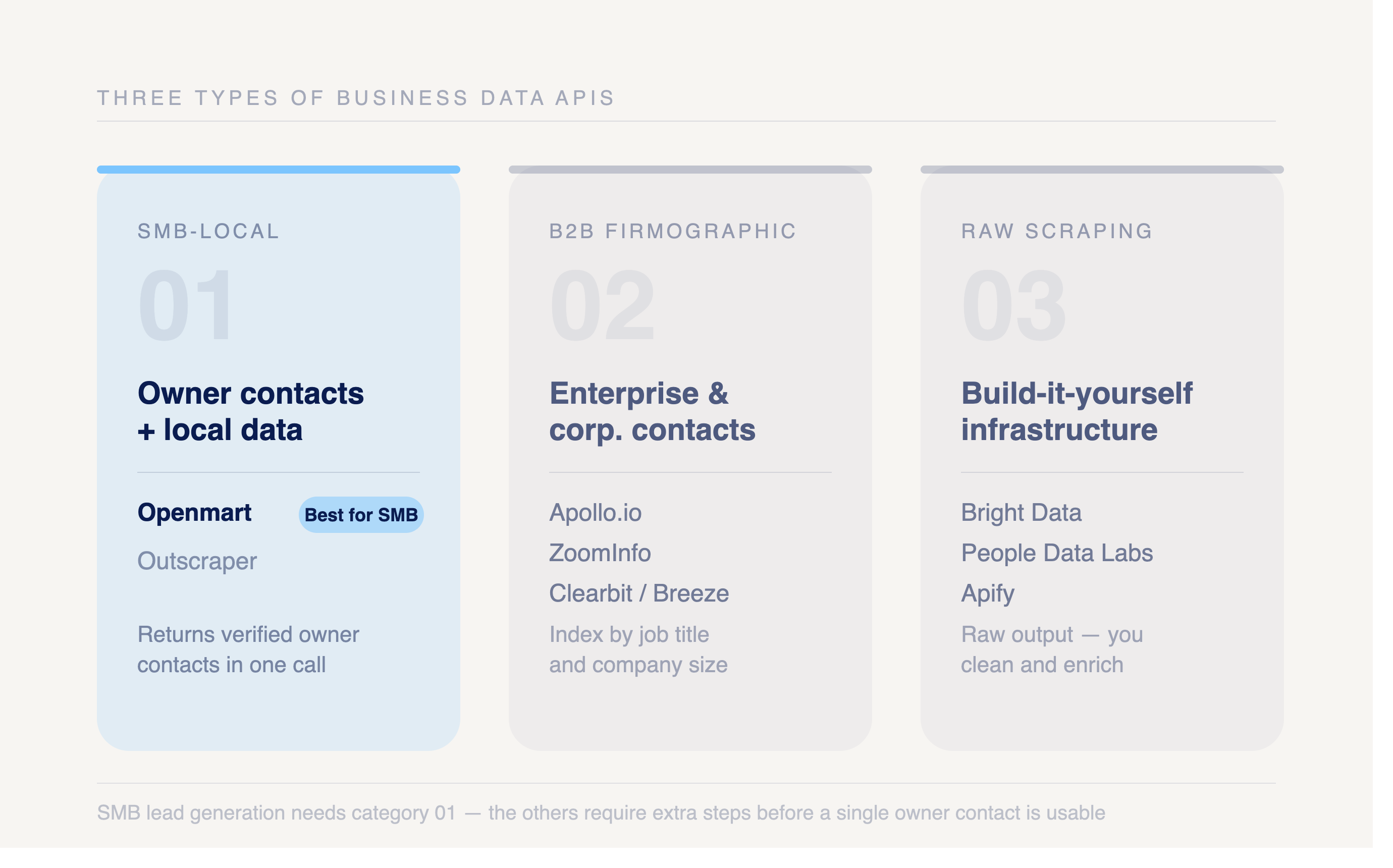
SMB lead generation needs data the enterprise B2B tools rarely carry. You want the owner's direct phone and personal email, dense coverage of plumbers and dental clinics by ZIP code, and Google Maps fields like ratings and review counts. A firmographic database optimized for VP titles at 5,000-employee companies returns thin results for a three-person landscaping business.
Judge any tool against the same baseline. Sub-200ms response times, 97%+ stated accuracy, and the ability to process 1M+ records per day separate production-grade APIs from hobby scrapers. The criteria below show which tools clear that bar for SMB use cases.
The 8 Best Business Data APIs for SMB Lead Generation
We ranked these eight APIs on four things that decide an SMB lead generation project: how much local business data they actually hold, how accurate that data is, how their API scales under high-volume calls, and whether their pricing is transparent enough to forecast. Openmart takes the top spot because it solves the SMB problem directly. Every competitor below it gets judged on the same criteria, even where the verdict goes against the top pick.
1. Openmart
Best for: Local SMB and Google Maps data extraction with verified owner contacts.
Openmart runs on a database of 200M+ local business listings across 300+ industry categories, with a stated accuracy of 97–99% maintained through continuous validation and refresh cycles (Openmart Local Business API). Each record returns 40+ verified fields. That goes well beyond name and address into owner personal email, owner direct phone, owner name, revenue range, employee count, tech stack, and the reservation system a business runs.
No other tool on this list returns owner personal email, owner direct phone, and tech stack alongside Google Maps data in a single call. Apollo and ZoomInfo weight their data toward enterprise B2B roles. Bright Data and Apify hand you raw scraped output that still needs enrichment. Openmart is the one API built around the person who actually owns the local business you want to reach.
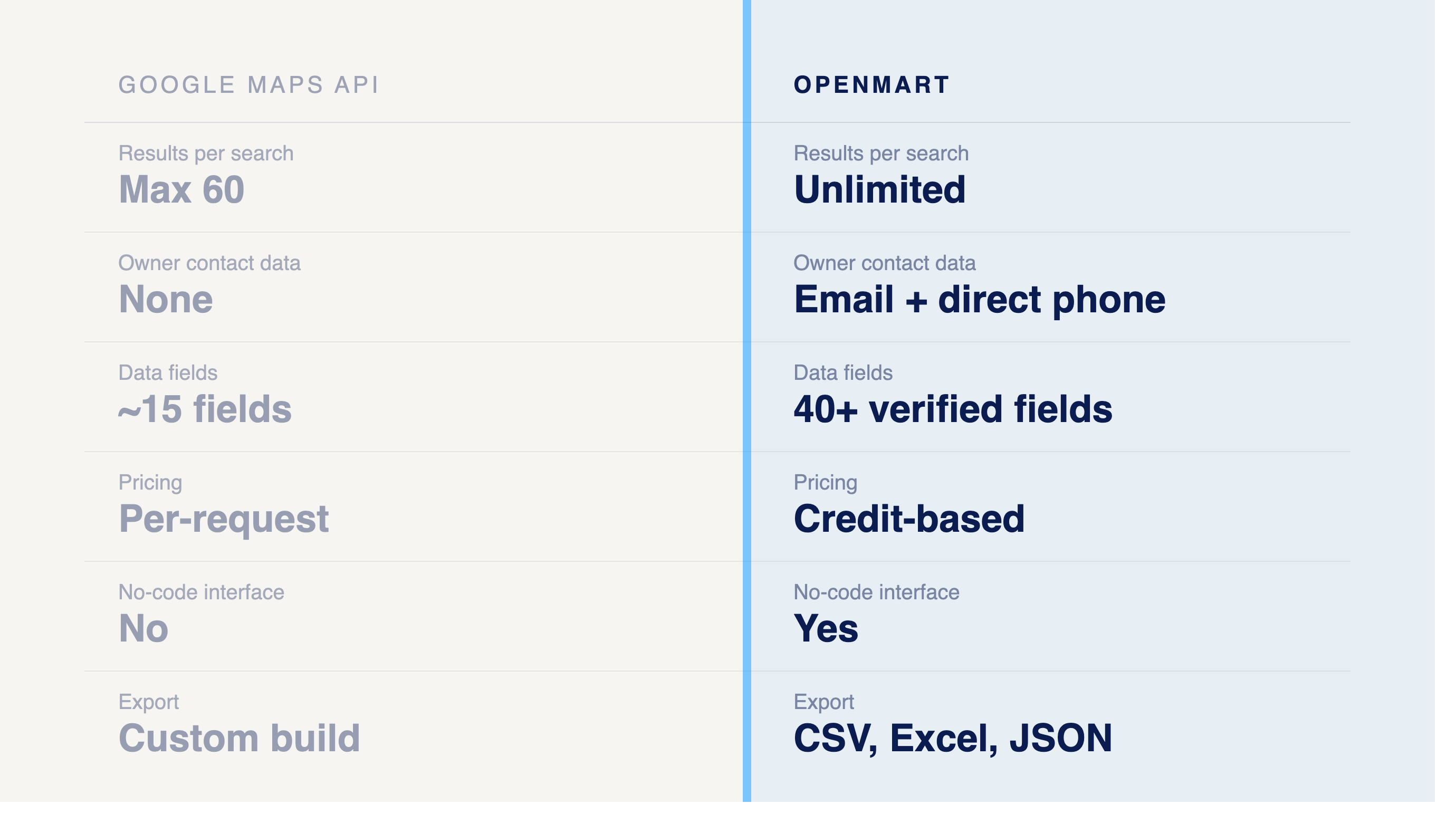
The gap shows clearest against the official Google Maps API, which Openmart benchmarks itself against directly.
The 60-place cap alone rules out the Google Maps API for any serious lead list. You hit the ceiling on a single dense ZIP code. Openmart returns the full set and attaches contact data Google never exposes.
Customer numbers back the positioning. Dana Bally, a sales leader at OneLocal, reported 12x ROI, 90% less prospecting time, and 3,000+ high-intent leads with 35% higher conversions. A Fortune 100 client updated 5,000+ businesses and pulled 3,000+ decision-maker emails for a 23% ROI. A billion-dollar marketplace platform processes 10,000+ profiles a month, onboards 3x faster, and saves roughly $30,000 per rep each year.
Pros
- 200M+ local listings across 300+ categories, the deepest SMB coverage on this list
- 97–99% stated accuracy backed by continuous refresh cycles
- 40+ verified fields per record, including owner personal email and direct phone
- Unlimited results per search versus the Google Maps API 60-place cap
- Real-time JSON responses with one-click CSV, Excel, and JSON export
- API key issued immediately on free registration, so you start pulling data the same day
Cons
- Numeric rate limits are not published. The product page describes infrastructure that handles "millions of requests seamlessly" without committing to a requests-per-minute figure
- Named CRM connectors are not listed. The API supports direct CRM push, but the page does not specify Salesforce, HubSpot, or Pipedrive by name
Pricing: Credit-based, which keeps cost predictable as volume grows instead of charging unpredictably per request. Exact tier costs live on the pricing page rather than the product page.
If your pipeline depends on reaching local business owners by their direct phone or personal email, Openmart is the only tool here that delivers that in one structured response. The rest of this list earns its place on other use cases, and several of them beat Openmart on documented rate limits or named integrations. None of them match its depth on local SMB data.
2. Apollo.io
Best for: B2B sales prospecting at scale with outreach automation built into the platform.
Apollo.io runs one of the largest contact databases in the category, with 230M+ contacts and 30M+ companies carrying verified emails and phone numbers. Each record carries job title, seniority, company size, industry, and buyer intent signals you can filter against. The platform spans roles from solo founders running their first outbound campaign to enterprise SDR teams managing thousands of sequences, and Apollo reports 600,000+ companies on the platform.
What separates Apollo from a pure data vendor is the outreach layer sitting on top of the database. You prospect, enrich, sequence emails, and run multi-touch campaigns inside one tool, so you skip buying a separate sequencer like Outreach or Salesloft. Apollo syncs that activity back to your CRM, and its compliance stack covers GDPR, SOC 2, CCPA, and ISO/IEC 27001 for teams that need it.
The weakness shows up the moment you need local SMB data. Apollo indexes B2B contacts by job function and firmographics, not Google Maps listings or owner direct lines for a dentist, restaurant, or auto shop. If your campaign targets local business owners, Apollo returns far fewer relevant records than Openmart. Apollo also keeps its API rate limits off its public pages, which makes capacity planning for high-volume enrichment harder before you sign up.
Pros
- 230M+ contacts with verified emails and phone numbers across 30M+ companies.
- Native Salesforce and HubSpot sync that pushes contact data, activity history, and campaign records back to your pipeline.
- Built-in email sequencing and multi-touch automation that replace a standalone outreach tool.
Cons
- Limited local SMB and Google Maps coverage, with thin owner-level contact data.
- API rate limits are not disclosed publicly, so you cannot size bulk jobs before testing.
Pricing: Apollo offers a free tier and scales into paid plans for growing sales teams. Specific tier costs, credit caps, and per-record pricing live at apollo.io/pricing and are not detailed in Apollo's public marketing pages.
Pick Apollo when your motion is B2B prospecting and you want the database and the sequencer in one subscription. For local business owners reached through Google Maps, a SMB-native API fits the job better.
3. ZoomInfo
Best for: Enterprise B2B firmographic data and intent-signal-driven prospecting.
ZoomInfo sells the deepest enterprise dataset on this list. You get firmographics, technographics, org-chart mapping, and buyer intent signals built for closing mid-market and enterprise accounts. Sales teams chasing six-figure deals at companies with 500+ employees lean on ZoomInfo precisely because it knows who reports to whom and which accounts are researching your category right now.
That strength becomes a liability the moment you point ZoomInfo at SMB lead generation. The platform indexes companies, not the corner restaurant or the local HVAC contractor running a single-location business. You will not find owner personal emails or owner direct phones for a hardware store in a 30-mile radius, because that data was never the point. ZoomInfo's local business density runs thin where SMB-native tools like Openmart return verified owner contacts across 300+ categories.
Pricing reinforces the gap. ZoomInfo runs on annual enterprise contracts negotiated through a sales team, with seat-based and credit-based commitments that assume a funded sales org. There is no transparent per-record price and no free tier you can test in an afternoon. If your model is pay-as-you-go scraping for a few thousand local leads a month, the contract minimum alone will outprice the entire project.
Pros:
- Deep enterprise firmographic coverage with technographic and company-size detail
- Intent signals and org-chart data that surface buying-committee members at target accounts
Cons:
- Enterprise pricing model sits well above typical SMB budgets
- Limited local and owner-level contact data for small, single-location businesses
- Annual contract commitments are standard, with no pay-as-you-go entry point
Pricing: Contact sales. Enterprise-tier annual contracts are standard, and no public per-record or self-serve pricing is published.
4. Bright Data
Best for: Raw web scraping infrastructure and petabyte-scale data extraction pipelines.
Bright Data sells the plumbing, not the leads. The platform runs 400M+ residential proxy IPs across 195 countries and has extracted 5B+ records spanning 250+ domains, with 99.99% uptime backing the infrastructure (Bright Data). You point its Scraper APIs at a target and get structured output, but you bring your own logic for what to scrape and how to clean it.
The pricing rewards volume. Scraper APIs start at $0.75 per 1,000 records, while the Unlocker, Crawl, and SERP APIs start at $1 per 1,000 requests. Bright Data ranks #1 on G2, answers support tickets in under 10 minutes on average, and carries GDPR, CCPA, ISO, and SOC certifications.
Where Bright Data wins is reliability at scale. Its infrastructure holds a 99.95% success rate even on hostile targets, and the pre-built scraper APIs for LinkedIn, eCommerce, and social platforms save you the proxy and anti-bot fight. Native connectors push raw data straight into AWS, Databricks, and Snowflake, so your data engineering team gets clean inputs without a middle layer.
The problem for SMB lead generation is what comes out the other end. Bright Data gives you raw web data, not a verified local business record. There is no Google Maps owner contact dataset, no owner direct phone, and no pre-enriched email field waiting in a marketplace. You build that pipeline yourself, which means engineering time spent on parsing, deduplication, and contact verification before a single lead reaches your CRM.
If your team has data engineers and needs scraping infrastructure that survives anything you throw at it, Bright Data is the strongest option on this list. If you want local business owner contacts delivered ready to use, you will spend weeks building what Openmart returns in a single API call.
Pros
- Petabyte-scale infrastructure with a documented 99.95% success rate.
- Pre-built scraper APIs for LinkedIn, eCommerce, and social platforms.
- Native AWS, Databricks, and Snowflake integrations for data pipelines.
Cons
- No SMB-specific or Google Maps owner contact data out of the box.
- Building an SMB lead gen pipeline requires real engineering effort.
Pricing: Scraper APIs from $0.75 per 1,000 records. Datasets Marketplace from $250 per 100,000 records.
5. People Data Labs
Best for: Developer-first person and company enrichment APIs with SDK support.
People Data Labs sells data as raw enrichment infrastructure, not a finished lead list. The API holds 3B+ person records and 100M+ company profiles, and you query it through SDKs in Python, JavaScript, Go, Ruby, and Rust. LinkedIn, Snowflake, HubSpot, and Clay all build on top of it, and the API earns a 4.3-star rating on G2.
The rate limits suit high-throughput pipelines. The free tier allows 100 requests per minute. Paid plans raise that to 1,000 requests per minute, and the bulk endpoint pushes throughput up to 100x per request by batching many records into a single call. You write to a clean, well-documented API, which is why engineering teams pick PDL over a no-code dashboard.
Coverage is the catch for SMB lead generation. PDL indexes professional identity data, so it returns strong results for software engineers, executives, and other roles with a heavy online footprint. Query a plumber, a dentist, or an independent restaurant owner and the match rate drops sharply. PDL also returns no Google Maps fields, no owner direct phone, and no intent or hiring signals, so you cannot build a local prospect list from it alone.
It also ships without native CRM connectors. To land enriched records in Salesforce or HubSpot, you wire PDL through Clay, Clearbit, or your own middleware. That adds engineering work and a second vendor before any lead reaches a rep. On security, PDL holds SOC 2 Type II and ISO 27001 certifications, which clears most procurement reviews.
Pricing rewards heavy use and penalizes idle credits. The Pro plan runs $98 per month for 350 enrichment credits, volume pricing starts around $0.004 per record, and Enterprise lands near $2,500 per month and up. Unused credits do not roll over, so you pay for what you provision rather than what you use.
Pros
- 1,000 req/min on paid plans with documented bulk throughput up to 100x per request
- SDKs in five languages and clean API documentation built for developers
- SOC 2 Type II and ISO 27001 certified
Cons
- No native CRM connectors, so you add Clay, Clearbit, or custom middleware
- No intent signals or hiring alerts for timing outreach
- Coverage thins for non-technical roles and SMB-segment companies
Pricing: Pro $98/month; volume pricing from roughly $0.004/record; Enterprise custom.
6. Outscraper
Best for: Budget-tier Google Maps scraping with pay-as-you-go pricing and no monthly fees.
Outscraper extracts Google Maps business data without locking you into a subscription. The platform has processed 763M+ cumulative tasks across globally distributed servers, returning more than 50 data columns per record. You pay only for what you pull, which makes it the cheapest entry point on this list for one-off or seasonal lead pulls.
Pricing starts free for your first 500 records. Beyond that you pay $3 per 1,000 records up to 100,000, then $1 per 1,000 once you cross the 100K threshold. There is no monthly commitment and no platform fee to keep an account active.
Each record covers reviews, popular times, Place ID, spatial index, and the standard business fields you'd expect from a Maps scrape. Owner contact data is not part of the core database. To get emails and phone numbers you add the enrichment option, which returns up to 3 emails, 3 phone numbers, and full social media links per business. That add-on enriches against the web rather than a pre-verified contact set, so coverage varies by how well-documented each business is online.
Outscraper connects to Zapier and HubSpot, and API access unlocks on the Medium and Business tiers. The no-code interface lets non-technical users run scrapes through a dashboard without touching the API at all. Sales ops people who want a quick list without engineering help can get one in an afternoon.
The trade-off shows up in speed and contact depth. Each scrape takes 7 to 25 minutes to process, so Outscraper suits batch jobs rather than real-time enrichment inside a form or workflow. And because there's no verified owner database underneath, you can't match Openmart's owner direct phone and personal email in a single call.
Pros: Transparent pay-as-you-go pricing with no monthly commitment. Over 50 fields per record including reviews, popular times, Place ID, and spatial index. No-code UI that non-technical users can run without API work.
Cons: Task processing runs 7 to 25 minutes per scrape. No pre-verified owner contact database, so emails come only through the enrichment add-on.
Pricing: Free for 500 records, then $3 per 1,000 up to 100K and $1 per 1,000 beyond.
7. Apify
Best for: Workflow automation pipelines that chain multiple scraping Actors and deliver finished records to your CRM.
Apify runs a marketplace of 38,660+ Actors, pre-built scrapers and automation tools that cover nearly every extraction job you can name. Its Google Maps Scraper alone has logged 449K runs at a 4.8/5 rating across 1,477 reviews. You assemble Actors into a pipeline rather than calling one endpoint, which makes Apify a platform for building lead workflows instead of a single data API.
A typical SMB build keys the compass/crawler-google-places Actor by ZIP and category, dedupes results on placeId, runs a contact scraper over the website column, then lets n8n merge the rows into HubSpot. That pipeline costs roughly $3 to $5 in credits for about 500 rows and returns 55 to 70% email coverage. Apify cites SDR and RevOps teams pulling 2,500+ qualified prospects per day through setups like this.
The developer economy behind the marketplace explains its breadth. Apify paid out $1.2M to Actor developers last month, and many earn over $3,000 per month publishing their own scrapers. That incentive keeps new Actors shipping faster than any single vendor could maintain.
Connector support is where Apify pulls ahead for automation work. You can route output through Make, n8n, Zapier, Google Sheets, LangChain, and vector databases like Pinecone and Qdrant. MCP connectors went live in 2026, so AI agents in Claude Desktop or Gemini CLI can read and write to external apps through a secure proxy inside a single run.
Pros
- 38,660+ Actors cover effectively every scraping and lead-gen use case you might need.
- MCP connectors are live, so you can wire Actors directly into AI agent pipelines.
- Anti-bot defenses and residential proxy rotation are built in, switching proxies when block rates pass 10% on a domain.
Cons
- Contact data accuracy depends on the individual Actor you pick, not a platform-wide guarantee, so two Google Maps scrapers can return different quality.
- Apify does not publish platform-level API rate limits, which makes capacity planning harder for high-volume runs.
Pricing: A free plan starts with no credit card. You pay at the Actor level after that. The Google Maps Scraper leads from $2.50 per 1,000 results, and Leads Finder runs $1.50 per 1,000 leads.
8. Clearbit / Breeze Intelligence
Best for: Enriching existing CRM records and scoring inbound leads inside HubSpot.
HubSpot acquired Clearbit in late 2023 and rebranded the product as Breeze Intelligence. The tool no longer competes as a standalone prospecting database. It exists to fill in the records you already have, scoring inbound leads and completing form submissions in real time so your sales team sees company size, industry, and role the moment a contact arrives.
That focus makes Breeze Intelligence strong inside HubSpot and weak everywhere else. If you run your entire pipeline in HubSpot, the enrichment fires automatically against new and existing contacts with no separate integration to maintain. The data lands in the same records your reps already work, which removes the sync step that every other tool on this list requires.
The problem starts when you need anything beyond HubSpot enrichment. Breeze Intelligence carries thin coverage on local SMBs and almost no owner-level contact data, so it cannot build a net-new prospect list of restaurants, clinics, or contractors in a given ZIP code. You can enrich a record you already captured. You cannot go find 3,000 local businesses and pull their owner emails. For SMB lead generation that depends on Google Maps density and direct owner phone numbers, that gap is disqualifying.
The HubSpot lock-in compounds the limitation. Teams on Salesforce, Pipedrive, or a custom stack get little value, since the product assumes you live inside the HubSpot ecosystem.
Pros
- Deep native HubSpot integration with automatic record enrichment
- Real-time inbound form enrichment and lead scoring
Cons
- Locked to the HubSpot ecosystem with limited value outside it
- Thin local SMB and owner-level contact data
- Built for enrichment, not net-new prospecting
Pricing: Bundled with HubSpot plans. Contact HubSpot sales for Breeze Intelligence access.
Rate Limits & Bulk Request Handling
The enterprise baseline for high-volume API work sits at sub-200ms response times, 99.9% uptime, and throughput of 1M+ records per day. Use those three numbers to judge whether an API survives a real lead generation pipeline that pulls thousands of records per hour. The tools below publish very different amounts of detail, and several disclose nothing at all.
Openmart describes its infrastructure as handling "millions of requests seamlessly" and publishes no numeric per-request cap (Openmart). That covers high-volume local pulls in practice, though you should confirm concurrency with their team before a large batch job.
Apollo.io does not document rate limits publicly. ZoomInfo also keeps its limits private and negotiates throughput per enterprise contract.
Bright Data publishes a 99.99% uptime figure and a 99.95% request success rate, with no per-request rate cap stated. Its proxy network absorbs burst traffic rather than throttling it.
People Data Labs gives the clearest published numbers. The free tier allows 100 requests per minute, paid plans raise that to 1,000 requests per minute, and the bulk API increases throughput up to 100x per request. That bulk endpoint matters most when you enrich a list of 50,000 records in one job.
Outscraper runs on globally distributed servers and has processed 763M+ cumulative tasks. Each scrape takes 7 to 25 minutes to complete, so plan around asynchronous task delivery rather than instant responses.
Apify runs Actors serverlessly with built-in scheduling and monitoring, and publishes no platform-level rate cap. Throughput depends on the Actor and your plan's compute units.
Clearbit / Breeze Intelligence does not document limits outside its HubSpot bundle.
When you evaluate any of these at scale, ask about burst capacity and priority queue handling. Sustained 1,000 req/min means nothing if a traffic spike triggers hard throttling mid-job.
SMB-Specific Data Coverage
SMB-specific coverage means four things: local business density across cities and ZIP codes, Google Maps extraction at scale, owner direct contact data, and filtering by industry category. Enterprise B2B databases miss most of this. They index headquarters and decision-makers at companies with employee counts, not the dentist, plumber, or coffee shop owner you actually want to reach.
Openmart returns 200M+ local business listings across 300+ industry categories, and each record carries owner personal email and owner direct phone alongside Google ratings, review counts, and tech stack detection. You query by city, state, ZIP, or a custom map area with no cap on results per search.
Outscraper covers Google Maps well, pulling 50+ data columns per record including reviews, popular times, and Place ID. Owner contacts arrive only through a paid email enrichment add-on, and there is no pre-verified owner database underneath.
Apify depends on which Actor you run. The Google Maps Scraper returns 30+ data points and posts a 4.8/5 rating across 449K runs, but contact accuracy shifts from one Actor to the next with no platform-level guarantee.
Apollo.io holds 230M+ contacts, yet the database skews toward enterprise B2B roles. You will find a VP of Sales faster than a local salon owner. ZoomInfo concentrates on enterprise firmographics, so local SMB density runs thin. People Data Labs sees coverage drop sharply for non-technical roles and smaller companies. Bright Data sells raw scraping infrastructure, which means building an SMB pipeline yourself before you see a single owner email.
Only Openmart delivers owner-level contacts and Google Maps data together in one API call. Every other tool on this list forces a choice between local coverage and verified owner contacts, or a custom build to stitch the two together.
CRM Integration
Enterprise CRM workflows expect three things from a data API. You want native connectors for Salesforce, HubSpot, and Pipedrive. You want webhook support with retry logic. You want payload customization so records map cleanly to your fields.
Openmart pushes records directly to your CRM through its API integration. The product page describes direct CRM push but does not name specific connectors like Salesforce or HubSpot, so confirm your platform before you build.
Apollo.io names Salesforce and HubSpot sync explicitly, carrying contact data and activity history into both. Apollo lists additional integrations beyond those two. ZoomInfo ships enterprise CRM integrations with Salesforce as the standard connector.
Bright Data points its output at data infrastructure rather than sales tools. You get AWS, Databricks, and Snowflake integrations with no native CRM connectors documented. People Data Labs takes the same stance and ships no CRM connectors at all, so you route records through Clay, Clearbit, or Workato to reach a CRM.
Outscraper covers Zapier and HubSpot, with API access on its paid tiers. Apify connects to Make, n8n, Zapier, Google Sheets, and MCP, and a typical lead pipeline runs a Google Maps scrape through n8n into HubSpot (use-apify.com). Clearbit, now Breeze Intelligence, integrates natively with HubSpot only, which limits you if you run any other CRM.
Two patterns separate these tools. Apollo, ZoomInfo, Outscraper, and Clearbit hand you named CRM connectors out of the box. Bright Data, PDL, and Apify expect you to build the delivery layer yourself through middleware or pipeline tools.
Match webhook expectations to your CRM standards before you commit. You want customizable payloads, retry mechanisms, and failure handling, none of which are documented uniformly across these vendors.
Pricing & Scalability
Three pricing models split this category, and each one rewards a different usage pattern. Pay-as-you-go bills per record with no commitment. Credit subscriptions trade a monthly fee for predictable volume. Enterprise contracts hide the number behind a sales call.
Outscraper and Apify sit at the bottom of the cost curve for SMB teams. Outscraper gives you 500 records free, then charges $3 per 1,000 records up to 100K and drops to $1 per 1,000 beyond that, with no monthly fee. Apify runs a free plan and prices per Actor, so the Google Maps Scraper starts at $2.50 per 1,000 results and you pay only for what you run.
Openmart and People Data Labs occupy the mid-tier. Openmart uses a credit-based model that keeps cost per record predictable across high volumes, with current tiers listed at openmart.com/pricing. PDL starts at $98 a month for 350 enrichment credits on the Pro plan, scales to roughly $2,500 a month for Enterprise, and lands near $0.004 per record at volume. Watch the fine print on PDL. Unused credits expire each cycle, so you pay for capacity you never touch.
Apollo.io anchors the accessible end with a free tier and paid plans for growing sales teams, with specifics at apollo.io/pricing. ZoomInfo and Bright Data's managed service run highest. ZoomInfo quotes only through sales on annual enterprise contracts. Bright Data charges $0.75 per 1,000 records for Scraper APIs, $250 per 100,000 records for its Datasets Marketplace, and $1,500 a month for fully managed extraction. Clearbit, now Breeze Intelligence, bundles into HubSpot plans rather than pricing as a standalone API.
For SMB lead generation, the ranking is clean. Outscraper and Apify win on entry cost. Openmart and PDL deliver predictable mid-tier economics at scale. ZoomInfo and Bright Data Managed price for budgets that SMB teams rarely carry.
How We Chose the Best Business Data APIs
We ranked these eight APIs against seven criteria, weighted toward what SMB lead generation actually demands.
SMB data coverage carried the most weight. We checked local business density, Google Maps extraction depth, and whether each API returns owner-level contact fields like a direct phone or personal email. Openmart returns 40+ verified fields per record across 300+ categories, which sets the bar.
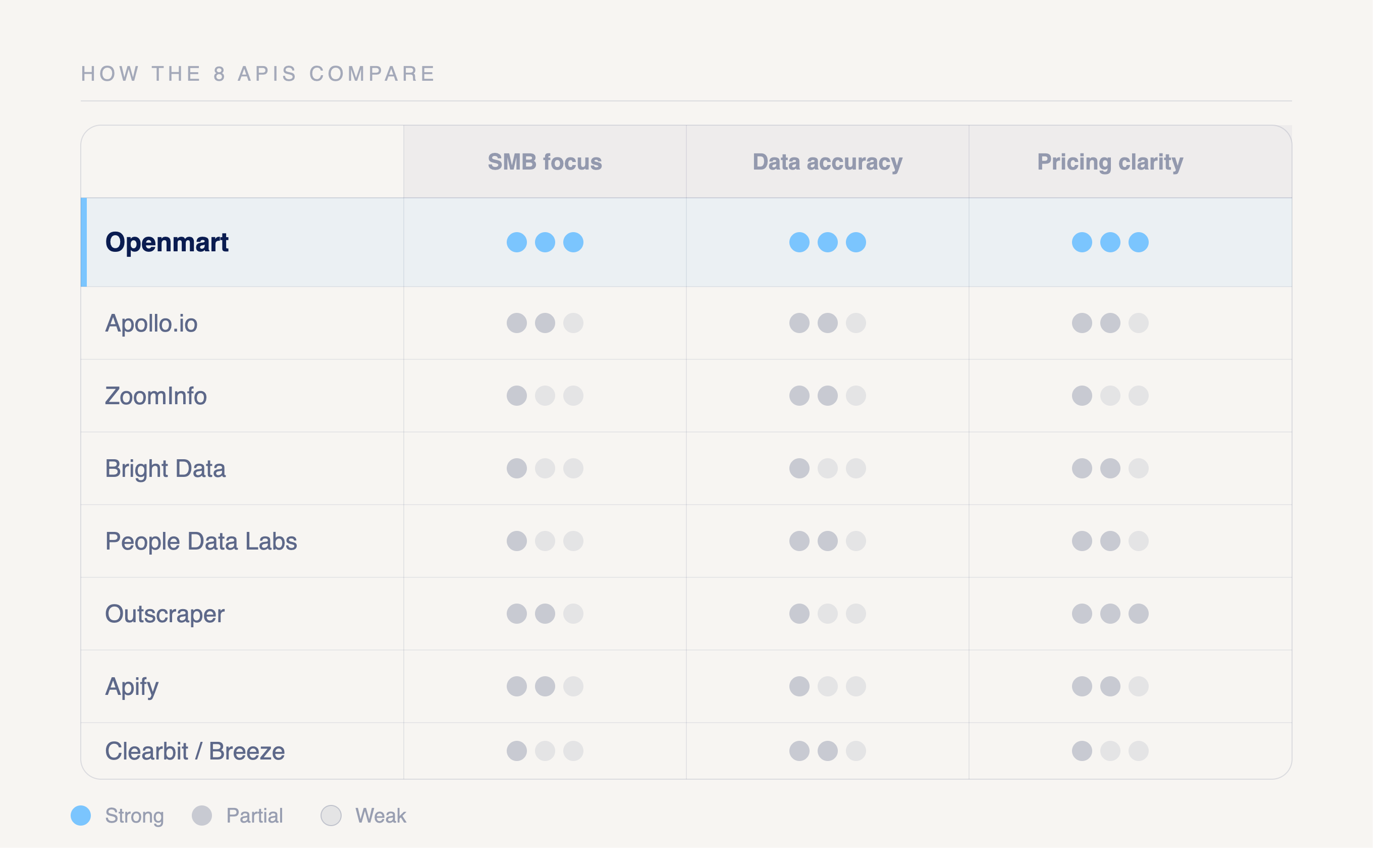
API scalability measured documented rate limits, bulk request handling, and uptime SLAs. Data accuracy looked at stated accuracy rates, verification methodology, and refresh cadence. Openmart publishes 97–99% accuracy with continuous validation, so we held competitors to that figure.
CRM integration rewarded native connectors and webhook support over tools that force you into middleware like Clay or Workato. Pricing transparency favored published per-record costs and free tiers over hidden enterprise contracts.
Developer experience covered SDK availability, documentation quality, and how fast you can make a first call. Openmart issues an API key the moment you register a free account.
Compliance checked for GDPR, SOC 2, and CCPA certifications, table stakes for any API touching contact data at scale.
Which Business Data API Should You Use?
Pick the tool that matches the data you actually need, not the one with the biggest database. Each of the eight APIs solves a different problem, and the wrong fit costs you either money or accuracy.
Local SMB leads with owner contacts → Openmart. You get 200M+ local listings with owner email, direct phone, and Google Maps data in one call.
B2B sales prospecting with built-in outreach → Apollo.io. 230M+ contacts paired with email sequencing replaces a separate outreach stack.
Enterprise firmographic data and intent signals → ZoomInfo. Deep org-chart data and buyer intent justify the enterprise contract for mid-market and enterprise teams.
Petabyte-scale raw web scraping infrastructure → Bright Data. You build the pipeline, Bright Data supplies the proxies and scraper APIs.
Developer-first person and company enrichment with bulk throughput → People Data Labs. SDKs in five languages and a 1,000 req/min paid limit suit engineering teams enriching at volume.
Budget Google Maps scraping, pay-as-you-go → Outscraper. Pricing starts free for 500 records and drops to $1 per 1,000 at scale, with no monthly commitment.
Multi-source workflow automation pipelines → Apify. 38,660+ Actors plus n8n and MCP connectors chain scrapers into CRM delivery.
HubSpot CRM record enrichment → Clearbit / Breeze Intelligence. Native HubSpot integration enriches existing records and scores inbound leads.
For any workflow that needs local business owner contacts and Google Maps data in a single API call, no competitor matches Openmart's coverage depth.
Explore the Openmart Local Business API
FAQs
What is a business data API?
A business data API gives you programmatic access to structured business contact and firmographic records through API calls. You use it to power prospecting, enrich existing records, and build lead lists at scale without manual data entry. Openmart delivers 200M+ local business listings with 40+ verified fields per record.
How do I choose the right business data API for SMB lead generation?
Prioritize owner-level contact data and local business density over raw contact volume. Check the rate limits, bulk request handling, and CRM integration paths against your expected call volume. Match the pricing model to your usage, since per-record billing suits low volume and subscriptions suit steady high volume.
Is Openmart better than Apollo.io for local business leads?
Apollo.io covers 230M+ contacts weighted toward enterprise and corporate roles. Openmart covers 200M+ local listings with owner direct phone and personal email attached to each business. For SMB and local business targeting, Openmart returns more relevant fields per record.
What is the difference between a scraping API and a business data API?
Scraping APIs like Bright Data and Apify extract raw web data that you then clean and structure yourself. Business data APIs like Openmart and People Data Labs deliver pre-verified, structured records ready to use. SMB lead generation needs structured owner contacts, not raw HTML you have to parse.
What rate limits should I expect from a business data API?
Enterprise-grade APIs target 1,000+ requests per minute, 99.9% uptime, and sub-200ms responses. People Data Labs documents 1,000 req/min on paid plans and adds up to 100x throughput through its bulk API. Openmart states its infrastructure handles millions of requests with no published numeric cap.
How quickly can I generate leads with a business data API?
Openmart issues your API key immediately on free registration, so you can pull records the same day. Outscraper completes scraping tasks in 7 to 25 minutes. An Apify pipeline runs roughly $3 to $5 per 500 rows with 55 to 70% email coverage.
What is the best alternative to ZoomInfo for SMB lead generation?
ZoomInfo runs on enterprise contracts and firmographic data with limited local SMB coverage. Openmart provides SMB-native local data with owner contacts and a lower entry cost. Apollo.io offers a free tier for B2B prospecting as a mid-tier option.
Do business data APIs integrate with Salesforce and HubSpot?
Apollo.io provides named native Salesforce and HubSpot sync with activity history. People Data Labs requires Clay, Workato, or custom middleware to reach a CRM. Openmart supports direct CRM push via its API, though it lists no named connectors yet.
Related articles


Start reaching local businesses today
No credit card required
100 free verified contacts


.png)
