.svg)
Openmart vs ZoomInfo: Which Is Better for SMB Prospecting?
TL;DR Verdict
Openmart wins for SMB prospecting. ZoomInfo wins for enterprise accounts. If you sell into local service businesses, restaurants, or owner-operated firms, Openmart's 200M+ local listings reach the market ZoomInfo's LinkedIn-indexed database misses. If you target Fortune 500 companies with tech stacks and funding signals, ZoomInfo earns its contract.
Category Verdict Coverage Openmart for SMBs, ZoomInfo for enterprise Pricing Openmart wins on transparency and accessibility Ease of Use Openmart consolidates a 4-5 tool workflow SMB Data Depth Openmart wins with 40+ verified fields per record Best For Openmart for local and SMB sellers, ZoomInfo for large-account teams
Skip to the section that matches your buyer.
Why This Comparison Matters
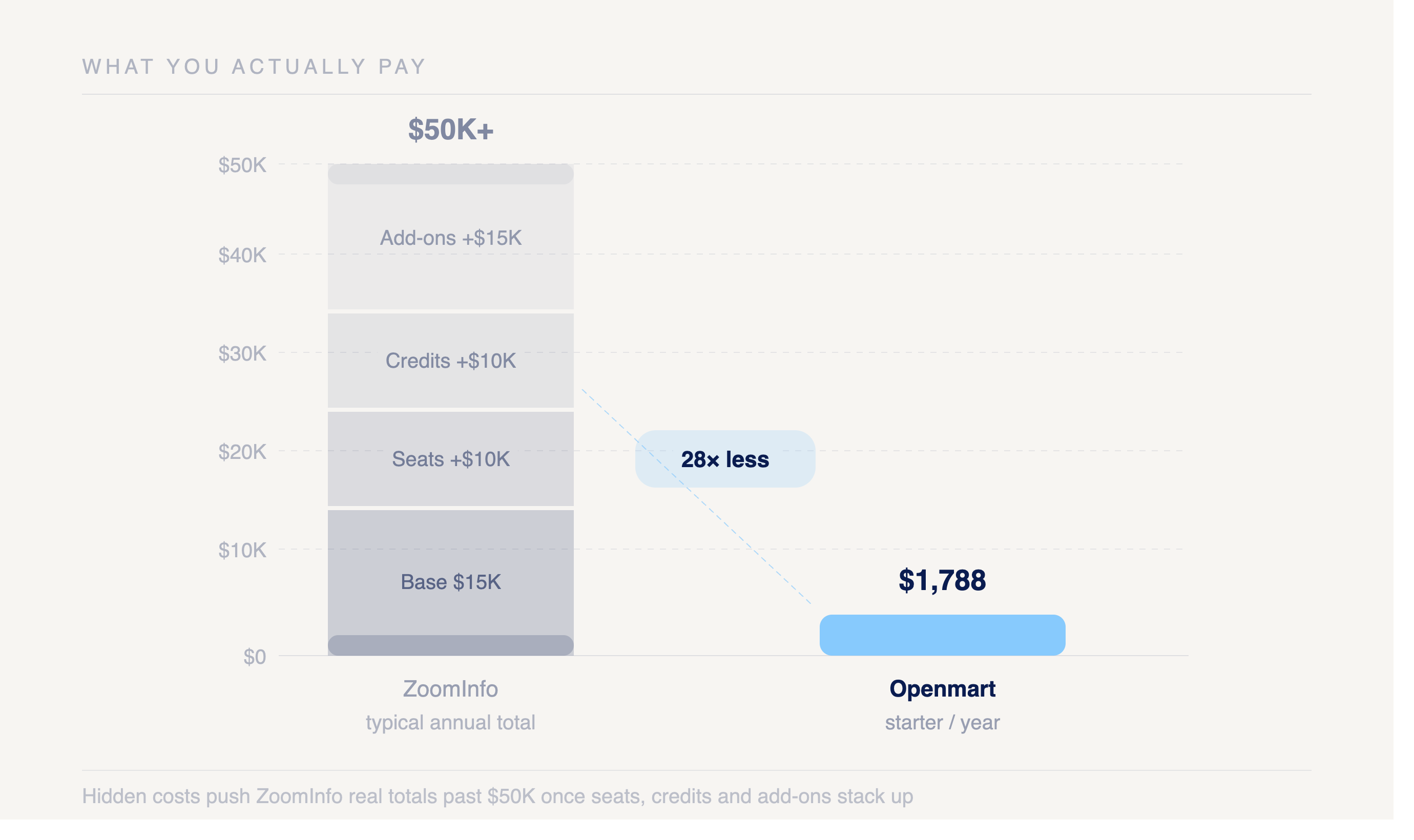
ZoomInfo built its database to index companies with LinkedIn pages, funding rounds, and named tech stacks. That methodology works for Fortune 500 targeting and fails the 30 million-plus brick-and-mortar businesses across the US. An HVAC company, a family-owned distributor, or a local accounting firm rarely posts funding news or maintains a corporate LinkedIn presence, so ZoomInfo's pipelines never see them. Teams running SMB prospecting on ZoomInfo or Apollo are missing 60 to 80% of their addressable market for that reason. You still pay enterprise rates. A three-seat ZoomInfo contract runs roughly $15,000 a year, and most teams cross $50,000 once seats and credits stack up. So you write a procurement check sized for Fortune 500 data and receive coverage that skips most of the small businesses you sell to.
Database Coverage: SMBs vs. Enterprise Targets
Openmart and ZoomInfo build their databases from opposite starting points, and the gap shows the moment you prospect a local service business. Openmart indexes 200M+ local business listings across 500+ categories and 300+ industries, pulling from Google Maps, review platforms, and licensing data (openmart.com). ZoomInfo indexes companies that already have LinkedIn pages, funding announcements, and visible tech stacks (origami.chat).
That methodology decides who you can find. ZoomInfo was "built for Fortune-500 prospecting, not the 30 million+ brick and mortar businesses across the US," which means HVAC contractors, restaurants, dentists, and owner-operated accounting firms fall outside its pipeline (openmart.com). Teams running SMB campaigns on ZoomInfo or Apollo "are probably missing 60-80% of your addressable market" because those tools prioritize companies with structured digital footprints (origami.chat). Openmart organizes the same verticals by both business type and metro area, so you can pull every salon in San Francisco rather than only the ones a partner happened to claim on LinkedIn.
Coverage method also determines how fast your list rots. The Bureau of Labor Statistics data shows roughly 20% of small businesses fail within their first year and half within five (origami.chat). A database refreshed on periodic cycles keeps showing companies that closed in 2019, while Openmart's real-time extraction reflects who is actually open today.

Data Quality and Enrichment Depth
Openmart attaches 40 to 50+ verified fields to every business record, and ZoomInfo gives you basic firmographics for the same SMB. Open a single Openmart record and you see the owner's name, owner email, direct phone, social profiles, a revenue estimate, employee size, and tech stack (openmart.com). ZoomInfo frequently lacks accurate annual revenue for small businesses and offers little firmographic depth in niche verticals (openmart.com).
The owner-contact gap comes from how each platform sources data. ZoomInfo leans on LinkedIn to identify business owners, which skips the millions of plumbers, salon owners, and accountants who never update a profile (openmart.com). Openmart pulls from web data, review platforms, and social pages, so it returns verified owner emails and direct dials where ZoomInfo returns blanks.
Stale records make the gap worse. A senior SDR manager at a home services software company said his team "spent 60% of prospecting time just confirming whether a business was still operational," because ZoomInfo would surface a company from 2019 that had already closed (origami.chat). Verified, current fields put that hour back into actual selling.
Pricing: What You Actually Pay
ZoomInfo hides every number behind a sales call, so the figures below come from buyer-reported data, not the company's own pricing page.
Plan Annual Cost Credits Professional ~$15,000 5,000 Advanced ~$25,000 10,000 Elite $40,000+ 15,000–20,000
Those are entry numbers. Most teams pay far more once they add seats, exhaust their credits, and buy the features that make the tool useful. ZoomInfo's pricing starts at $15,000 a year, but hidden costs routinely push real totals past $50,000 (fiftyfiveandfive.com).
The structure works against a small team in four ways. You cannot see a price without booking a demo. You cannot pay monthly, since every contract locks you in for twelve months. You cannot export freely, because data exports and enrichment burn credits that run out. You cannot start small, since the minimum viable contract runs about $15,000 for three seats (factors.ai).
Discounts exist. ZoomInfo and Cognism both negotiate, and buyers with leverage have secured 30–65% off (Vendr). Getting that discount takes time, competing quotes, and a procurement process. A four-person sales team rarely has any of those, so the SMB buyer pays closer to list while the enterprise account negotiates it down.
Openmart prices the opposite way. The figures sit in front of you, you sign up and evaluate the data without scheduling a call, and you pay for the SMB records you actually pull rather than reserving enterprise capacity you never touch. For a team that wants to test prospecting data this week instead of opening a vendor evaluation, that difference decides the purchase before coverage or accuracy ever enters the conversation.
Ease of Use and Workflow Integration
A ZoomInfo rep prospecting into SMBs runs four or five tools that don't talk to each other. They browse in LinkedIn Sales Navigator, pull contacts from ZoomInfo, open Google Maps to confirm the business still exists, then reconcile everything in a spreadsheet (origami.chat). Every gap in ZoomInfo's coverage forces another round of manual verification.
Openmart collapses that stack into one platform. You type an ICP query in plain language through Openclaw, like "Find hair salons in San Francisco with 2+ locations, revenue $1M–$10M" (openmart.com). The agent runs multi-step scoring and hands back a ranked lead list, verified owner-level contacts, and outreach emails already drafted against each business's specific details.
You skip the LinkedIn browsing because Openmart finds owners through web, review, and social sources. You skip the Google Maps check because every record carries an opening-status field. You skip the spreadsheet reconciliation because the output ships as scored_leads_ranked.csv, decision_maker_contacts.csv, and personalized_outreach_emails.md. Three tools and a manual verification loop become one query.
Head-to-Head Comparison Table
Openmart ZoomInfo Database Size 200M+ local business listings Enterprise-indexed, LinkedIn-dependent SMB Coverage 500+ categories, 300+ industries Misses 60–80% of SMB market Data Fields per Record 40–50+ verified fields Basic firmographics for SMBs Contact Accuracy Method Multi-source (web, social, reviews) LinkedIn-reliant Pricing Model Transparent, accessible Opaque, sales-call required Contract Flexibility No procurement required Mandatory 12-month annual Ease of Signup Self-serve Demo-gated for paid plans Ideal Customer SMB prospecting teams Fortune-500 account targeting
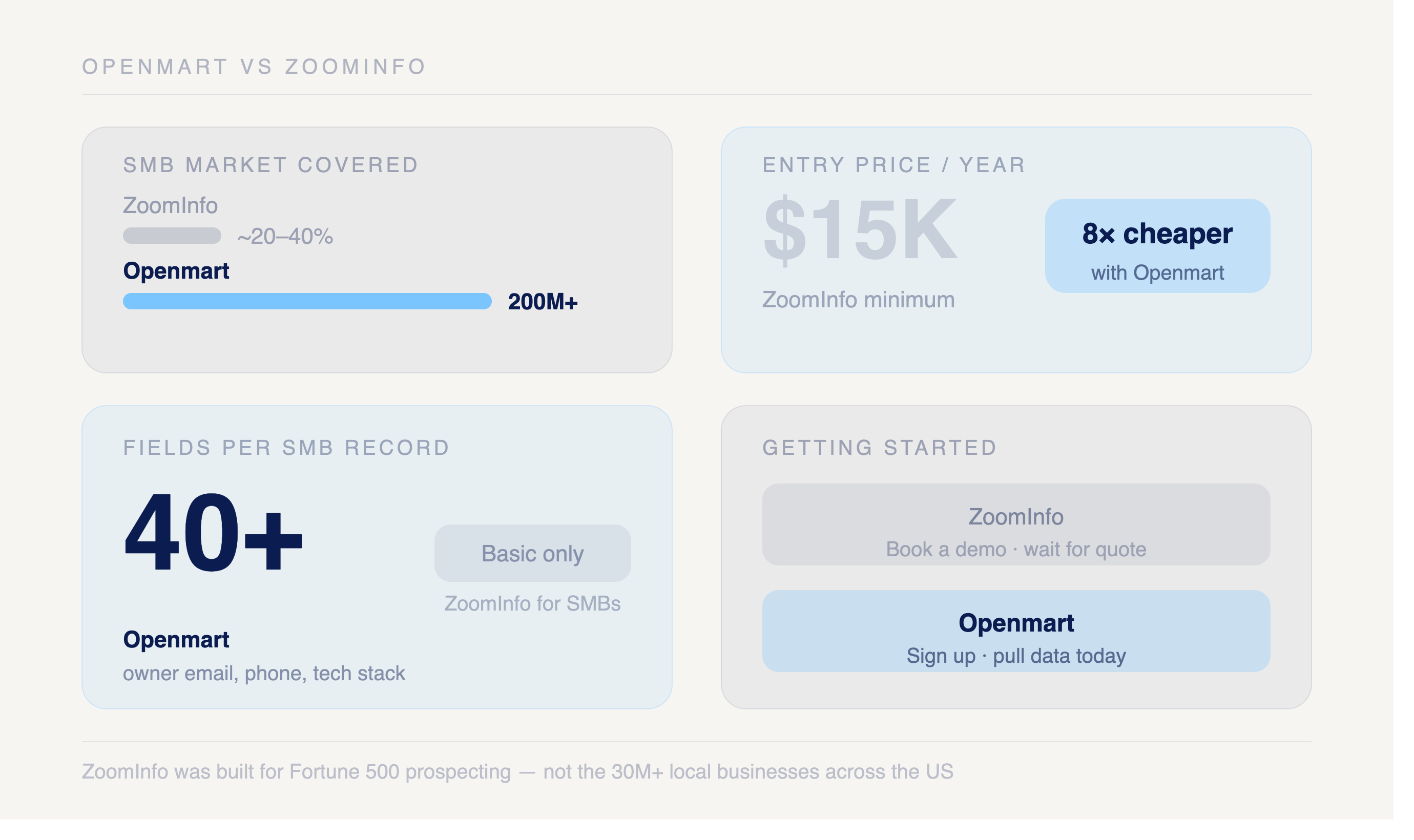
The rows above sort the two platforms by the decisions you actually make when you buy. Read the Coverage and Contact Accuracy rows if your ICP is local and owner-operated. Read the Pricing and Contract rows if your finance team needs to approve the spend before you can test the data.
Who Should Choose Openmart
Pick Openmart if your buyers run on Google Maps instead of LinkedIn. Three teams get the most out of it.
Field sales reps selling into local service businesses win first. If you sell point-of-sale hardware, insurance, or financing to HVAC techs, electricians, and plumbers, ZoomInfo hands you a list built around companies with funding rounds. Openmart pulls owner emails and direct phones for owner-operated shops that never show up there.
SDRs targeting restaurants, cafes, salons, and home services hit the same wall with Apollo. Those reps burn hours confirming a business still exists. Openmart's real-time Google Maps data and verified decision-maker contacts cut that verification step out.
SMB-focused SaaS teams with a tight prospecting budget are the third fit. You cannot justify a $15K ZoomInfo contract to reach businesses it barely covers. Openmart's natural language ICP queries through Openclaw return scored lists and drafted outreach without a procurement cycle attached.
Who Should Choose ZoomInfo
ZoomInfo earns its contract when your buyers are mid-market and enterprise companies with LinkedIn presence, published funding rounds, and visible tech stacks. Its data pipelines index exactly these signals well, and its intent and scoops features help reps catch buying triggers at larger accounts. If your average deal closes at six figures and one good meeting pays for the seat, the $25,000-plus annual commitment makes financial sense. Sales teams chasing named accounts in software, finance, or other structured industries get reliable firmographics and direct dials there. The negotiation leverage to extract a 30-65% discount also tends to sit with these larger buyers (Vendr). For that profile, ZoomInfo remains the stronger pick.
Frequently Asked Questions
Is ZoomInfo worth it for small businesses? ZoomInfo is hard to justify for SMB sellers because its pricing and coverage both miss the target. The platform indexes companies with LinkedIn pages and funding signals, so owner-operated businesses fall outside its data pipeline. You pay enterprise rates for records that skip most of your addressable market.
What is ZoomInfo's cheapest plan? ZoomInfo's Professional tier runs roughly $15,000 per year based on buyer-reported figures, with the free Lite plan offering very limited credits. Compared to Openmart, that minimum commitment locks small teams into an annual contract before they confirm the data fits. Most teams then pay $30,000 or more once seats and credit packs stack up.
Does Openmart have a free trial or self-serve signup? Openmart sells SMB-focused data at an accessible price point without a procurement process. You evaluate the product directly rather than scheduling a demo. Small teams can start prospecting without committing to a 12-month contract.
How does Openmart find SMB owner contact info without LinkedIn? Openmart pulls owner emails and direct phones from web data, social pages, and review platforms instead of LinkedIn profiles. This multi-source method reaches owners who never maintain a professional profile. You get verified decision-maker contacts for plumbers, salons, and restaurants that ZoomInfo leaves blank.
Can Openmart replace ZoomInfo entirely? Whether Openmart replaces ZoomInfo depends on your ICP. If you sell into local service businesses and SMBs, Openmart covers the segment ZoomInfo misses. Teams targeting Fortune 500 accounts still benefit from ZoomInfo's enterprise firmographics.
Related articles

Start reaching local businesses today
No credit card required
100 free verified contacts


.png)
