.svg)
TL;DR
SMB contact enrichment fills the gaps in your records for small and medium-sized businesses, appending owner names, direct emails, phone numbers, and firmographic details to incomplete data. Sales teams selling to local and owner-operated businesses need it because enterprise data tools miss most of the market. Openmart sources data built specifically for SMBs, where ZoomInfo and Cognism focus on larger companies.
What Is SMB Contact Enrichment?
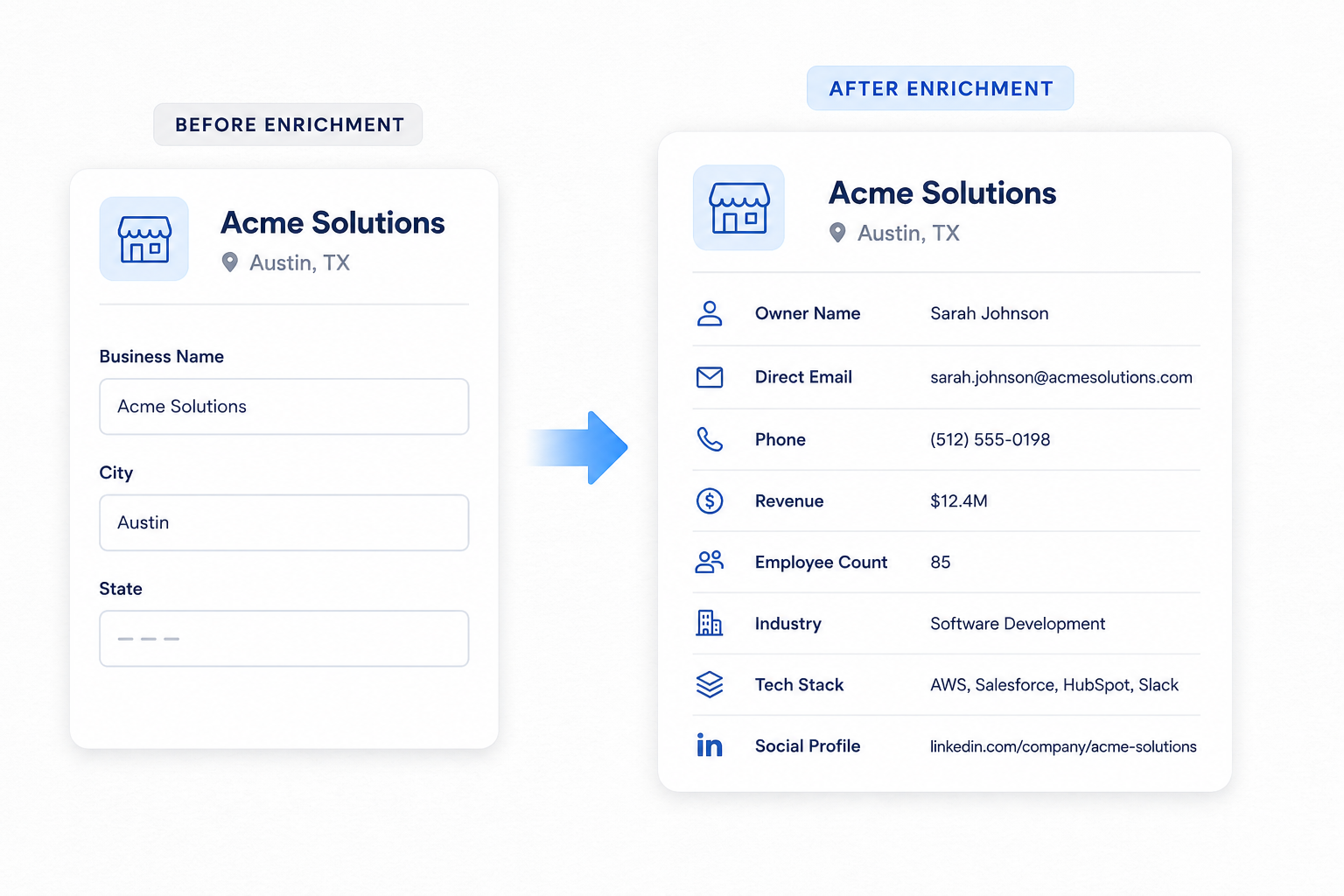
Contact enrichment takes a thin record and fills in the missing pieces. You start with something partial, often just a business name and a city. The enrichment process matches that record against external data sources and returns the fields you lack, including direct email, phone number, industry, and employee count.
SMB enrichment narrows this to small and medium-sized businesses, and that distinction changes everything about the data. A 12-person plumbing company does not file public revenue reports or maintain a LinkedIn page for every employee. The owner is often the buyer, the decision-maker, and the person answering the phone. Enterprise data pipelines built around corporate filings and large org charts return almost nothing useful for these businesses.
General B2B data enrichment and lead enrichment overlap with SMB enrichment but aim at different targets. B2B enrichment usually means mid-market and enterprise accounts with deep firmographic profiles. Lead enrichment describes the timing, enriching a record the moment a lead enters your funnel.
The core job stays the same across all three. You hand over an incomplete record, and the tool returns a complete one you can actually call or email.
How SMB Contact Enrichment Works
You start with whatever you have. That might be a full business name, a domain, a phone number, or a half-complete CRM record with a company and a city. The enrichment engine matches that input against its data sources, finds the corresponding business, and returns the missing fields you asked for.
You can feed records to an enrichment tool three ways. Upload a CSV for bulk processing when you want to clean an existing list in one pass. Call a real-time API when you need a record enriched the moment a lead converts on your site. Connect a CRM integration when you want HubSpot or Salesforce contacts enriched automatically as they enter your pipeline.
Vendors build their data through a mix of methods. Some crawl the public web, pulling business listings, registration records, and company websites. Others license datasets from third parties or collect contributions from their own user base. Each approach trades off coverage against freshness against compliance risk, and most vendors blend several. Treat any single-source claim with skepticism. What matters for your outreach is whether the returned data is current and legally sourced, which you can only confirm by testing it against records you already know.
Data Fields Returned by SMB Contact Enrichment
A complete enrichment record falls into three buckets. Firmographic fields describe the business itself. You get the legal and trade name, physical address, employee headcount, estimated revenue, and industry classification. For local businesses, this layer often extends to operating hours, store count, and franchise affiliation.
Contact fields put a person behind the business. The owner or decision-maker name, a direct email, and a phone number form the core. A useful SMB record names the actual owner-operator rather than a generic info@ inbox or a corporate switchboard.
Technographic and intent signals round out the picture where a vendor can source them. Technographic data tells you what software a business runs, like the point-of-sale system a restaurant uses or the booking platform a salon relies on. Intent signals flag businesses showing buying activity, though these stay sparse for smaller companies that leave little digital trace.
Two fields stay genuinely hard to get for SMBs. A direct mobile number and a verified owner email both depend on data that small businesses rarely publish, so coverage runs well below what you would see for enterprise contacts at large firms with public filings and LinkedIn-active executives. A solo operator running a landscaping company leaves far less behind than a VP at a Fortune 500.
Coverage swings hard by vendor and geography. A provider strong on US local businesses may return almost nothing for a German Mittelstand firm, so test against your actual target region before you trust the headline numbers.
Accuracy Benchmarks to Expect
Judge an enrichment vendor on four numbers. Match rate measures how many of your input records get any data back. Email deliverability rate tells you how many appended emails reach an inbox without bouncing. Phone connect rate shows how often a number actually rings the right person. Data freshness tracks how recently each record was verified.
SMB benchmarks sit below enterprise figures, and that gap is expected. Small businesses change addresses, owners, and phone numbers more often than large firms, and most file no public records you can cross-check. Expect match rates of 50 to 70 percent, email deliverability of 85 to 92 percent, and phone connect rates of 25 to 40 percent. A vendor quoting 95 percent across the board on local businesses is measuring something other than the segment you sell to.
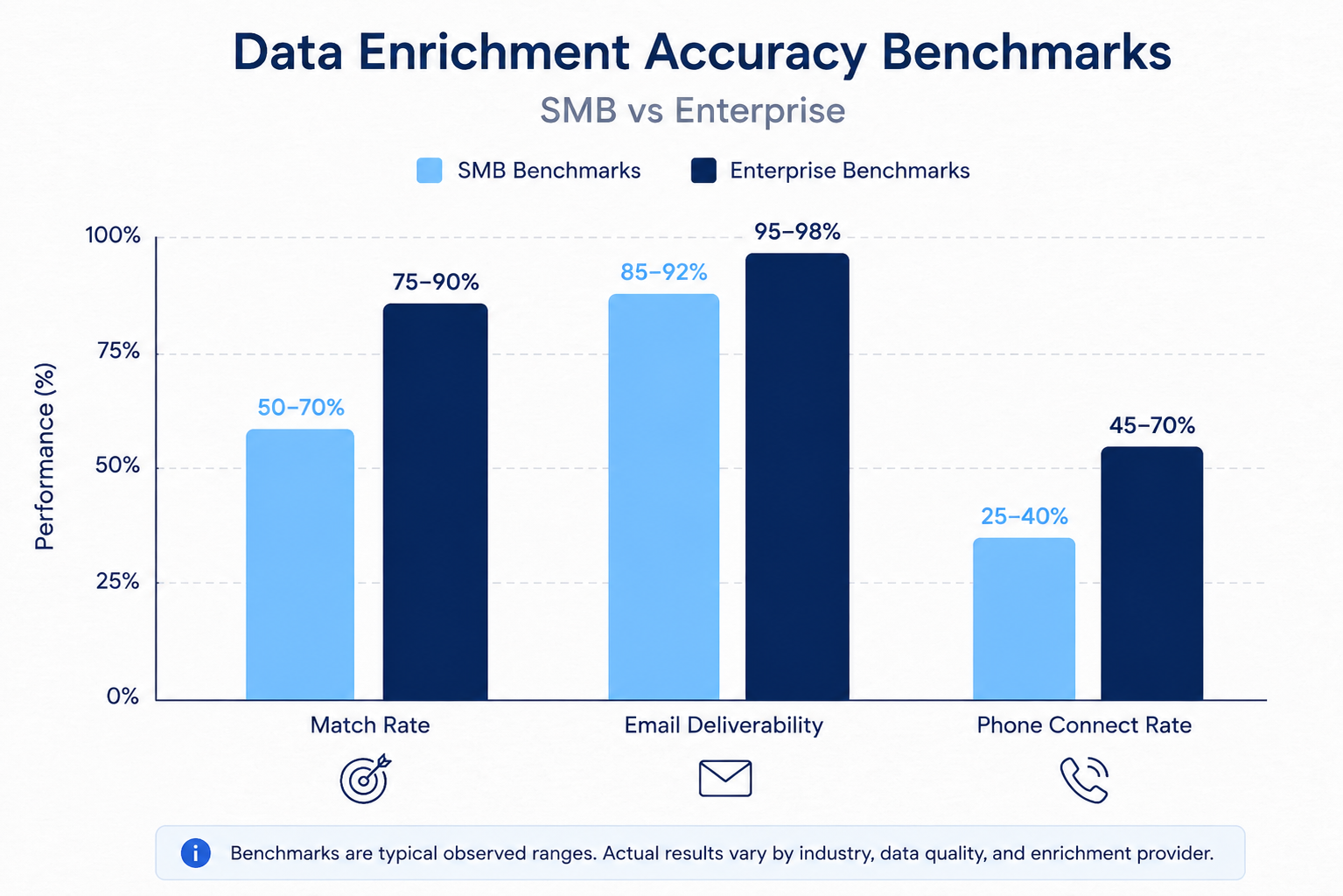
Run a sample before you sign anything. Upload 200 to 500 of your real target accounts, then measure the four numbers against your own outreach results. A free test on your own data beats any benchmark a sales rep recites.
Compliance Considerations: GDPR and CAN-SPAM
Two frameworks govern most SMB outreach, and you need to understand both before you send a single email. GDPR covers any contact you touch in the EU or UK, regardless of where your company sits. CAN-SPAM governs commercial email sent to US recipients.
GDPR does not ban B2B prospecting. It requires a lawful basis, and "legitimate interest" is the one most sales teams rely on. You can email a business contact about a product relevant to their role if you document why the outreach is proportionate and offer an easy opt-out. CAN-SPAM sets a lower bar. Use a real sender address, an honest subject line, a physical mailing address, and a working unsubscribe link.
Compliance splits across two parties. The vendor is responsible for sourcing data lawfully and disclosing how it was collected. You are responsible for how you use that data once it lands in your CRM.
Treat a vendor's compliance badge as a starting point, not a guarantee. If a provider scraped owner emails without a lawful basis, that liability follows the data to you. Ask any vendor exactly where their contact records come from before you trust the certification.
SMB Contact Enrichment Tools Compared
The enrichment market splits along a clear line, with enterprise-first platforms on one side and SMB-native tools on the other, and the right pick depends entirely on whether you sell to Fortune 500 buyers or to the dentist down the street.
Tool SMB Data Coverage Key Strength Pricing Model Compliance Certifications Best For Openmart High, including local and micro-businesses Owner-operator contacts and verified local business data Usage-based credits GDPR, CAN-SPAM aligned Teams selling to SMBs and local businesses ZoomInfo Low for SMBs, strong for mid-market and enterprise Deep firmographic and intent data on larger companies Annual seat-based contract GDPR, SOC 2 Enterprise sales teams Cognism Low for micro-businesses, strong in EU/UK mid-market Phone-verified mobile numbers, EU coverage Annual platform license GDPR, CCPA EU-focused B2B sales Apollo.io Moderate, skews toward tech and digital companies Combined database and outreach sequencing Freemium plus per-seat tiers GDPR, SOC 2 Startups running outbound at volume Clay Variable, depends on connected sources Workflow automation across many data providers Credit-based subscription Inherits source compliance Ops teams building custom enrichment pipelines
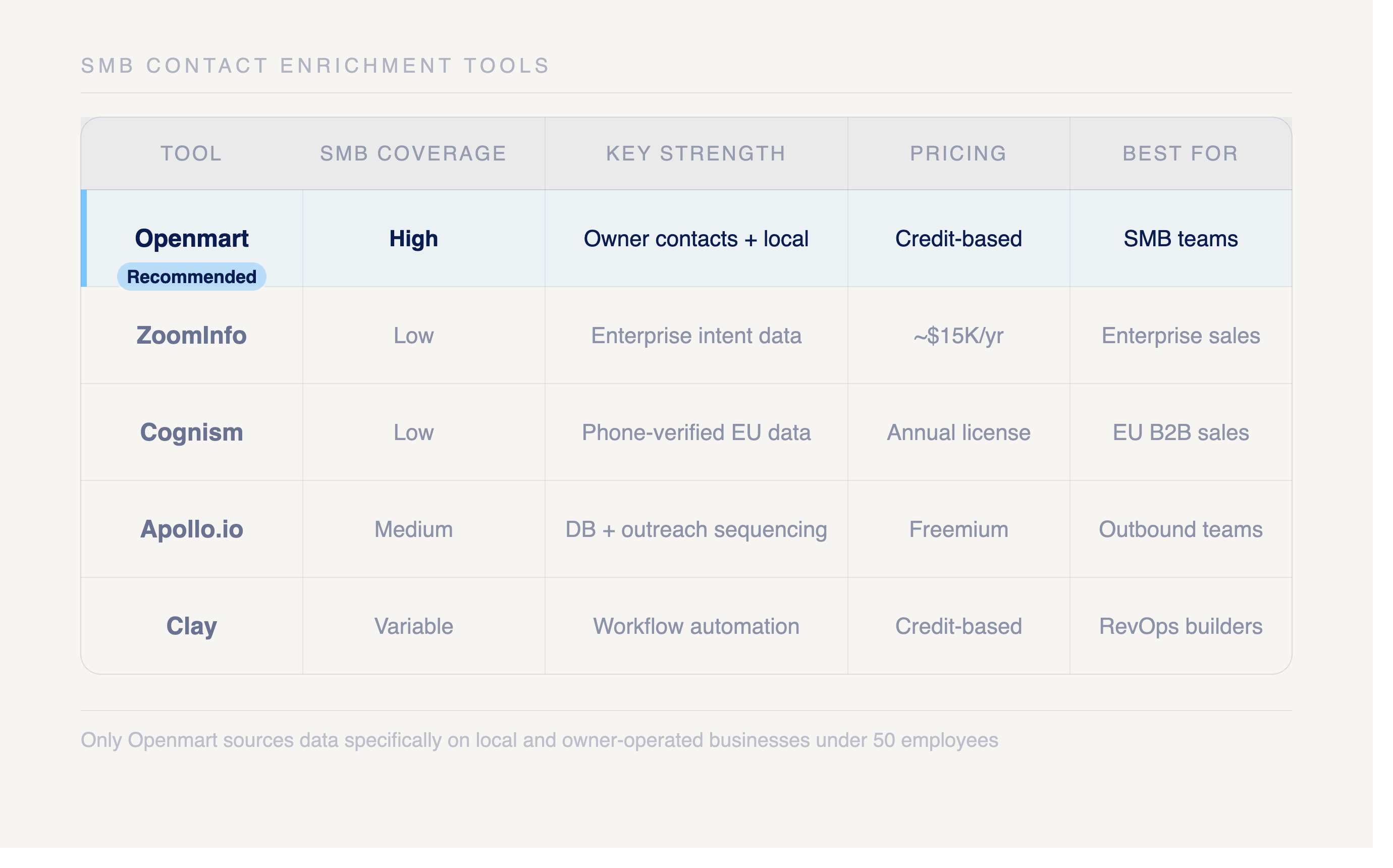
ZoomInfo and Cognism build their databases around companies that file public records, post job listings, and maintain large LinkedIn footprints. A 4-person plumbing company or a single-location restaurant rarely shows up in those signals, so you get blank fields or a generic info@ address. Apollo and Clay close some of that gap, but Apollo leans toward tech buyers and Clay's coverage rises and falls with whichever sources you wire into it.
Openmart sources data specifically on small and local businesses, which is why it returns owner names and direct contacts where enterprise tools return nothing. If your accounts are owner-operated businesses under 50 employees, that coverage difference decides whether your list is usable.
Why Openmart Is Built for SMB Contact Enrichment
Openmart builds its dataset around the businesses most enrichment tools skip. ZoomInfo and Cognism index companies that file public records, run LinkedIn pages, and employ named departments. A two-location dental practice or a family-owned HVAC company rarely shows up in those sources at all.
Openmart crawls local business listings, review sites, and public web pages to find the owner-operator behind a small business. You get the fields that matter for SMB outreach. Owner name, direct phone, business email, location count, and the categories a local business actually uses to describe itself.
That sourcing produces match rates on local and micro-businesses that enterprise tools cannot reach. When you upload a list of independent retailers or regional service firms, Openmart returns a usable record on a far higher share of them than a database tuned for mid-market and enterprise accounts.
The trade-off is honest. Openmart will not enrich a 50,000-person enterprise as deeply as ZoomInfo. If your buyers run businesses with one to fifty employees, that focus is the point. See Openmart for coverage in your target categories.
Frequently Asked Questions
What is the difference between contact enrichment and lead generation?
Lead generation finds new prospects you didn't have before. Contact enrichment fills in missing details on records you already hold, such as a phone number or industry code. Openmart enriches your existing SMB lists so your reps stop chasing dead records and reach real owners.
How accurate is SMB contact data compared to enterprise data?
SMB data carries lower match and deliverability rates because small businesses churn faster and file fewer public records. You should expect match rates below what enterprise vendors quote for large companies. Openmart sources from local business signals built for this segment, which lifts coverage on owner-operated firms.
Is contact enrichment legal under GDPR?
Yes, B2B prospecting can rely on legitimate interest as a lawful basis when you contact business roles for relevant offers. You still owe data subjects transparency and an opt-out. Openmart documents its sourcing so you can defend that basis during a review.
How often should enriched data be refreshed?
Refresh SMB records every three to six months because small businesses change address, ownership, and phone numbers often. Stale data drives bounces and wasted dials. Openmart lets you re-run enrichment on a schedule to keep fields current.
Can I enrich contacts directly in my CRM?
Yes, most tools push enriched fields into Salesforce or HubSpot through a native integration or API. Openmart connects to your CRM so records update without manual exports.
Conclusion
Pick an SMB enrichment tool by three things. Check the match rate against your actual target list, not a vendor's marketing average. Confirm the field coverage includes owner names and direct contacts for small and micro-businesses, since enterprise tools thin out fast below 50 employees. Verify the sourcing is compliant before you trust the compliance badge.
Run a sample list through any vendor you consider, then measure deliverability and connect rates yourself. If you sell to local and owner-operated businesses, test Openmart against your current data and compare the SMB coverage directly.
Related articles



Start reaching local businesses today
No credit card required
100 free verified contacts


.png)
