.svg)
TLDR
Openmart's Local Business API wins for SMB owner-level contacts. It indexes 200M+ local businesses with 50+ verified fields per record and hits 97–99% accuracy on key contact data.
Enterprise-first APIs like Apollo, ZoomInfo, and Cognism build their databases around corporate contacts. Offline SMBs and brick-and-mortar businesses fall through their coverage gaps, leaving you with generic info@ addresses instead of the owner.
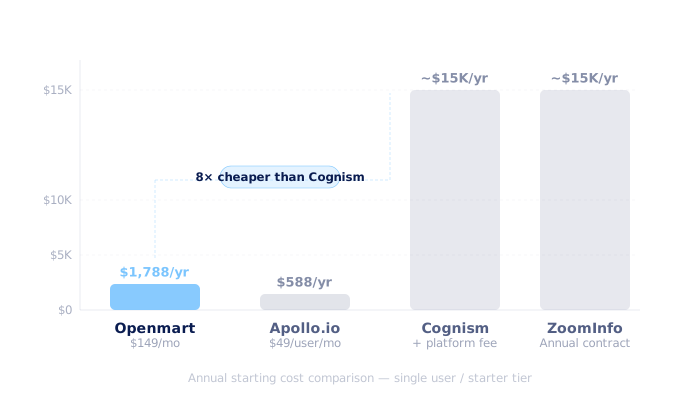
Openmart prices on credits starting at $149/month. ZoomInfo and Cognism run $15K–$60K/year on annual contracts before add-ons.
Sales engineers and growth teams targeting local businesses get owner, founder, and CEO contacts that enterprise tools never index. The API ships with Salesforce, HubSpot, and Clay integrations plus batch processing and real-time credit tracking.
Why local SMB owners slip through enterprise data tools
Your reps spend hours enriching leads only to land on a generic info@ inbox that nobody reads. The contact data exists. It just doesn't point to a person who can sign a deal.
Most B2B data APIs were built to map Fortune 500 org charts. They index corporate domains, buying committees, and VP titles at companies with thousands of employees. A 12-person HVAC company or a family-owned dental practice barely registers. The owner's direct email, the one that actually converts, never makes it into the database.
For years you had two bad options. Scrape Google Maps yourself and clean raw listings by hand, or pay $30K a year for an enterprise tool that still missed half your local targets.
Purpose-built SMB APIs now close that gap. They return owner, founder, and CEO contacts for local and brick-and-mortar businesses at credit-based pricing a developer can expense without a procurement meeting.
This guide ranks the best B2B data APIs for SMB lead generation in 2026, scored on coverage depth, contact accuracy, and pricing transparency. If you want the manual playbook first, read how to build a high-quality SMB prospect list.
What is a B2B data API?
A B2B data API is a REST endpoint that returns structured business contact and firmographic data on demand. You send a query and get back fields like company name, owner email, phone number, revenue range, and employee count in JSON. Sales engineers use these APIs to enrich CRM records, feed outreach tools, and build lead databases without manual research.
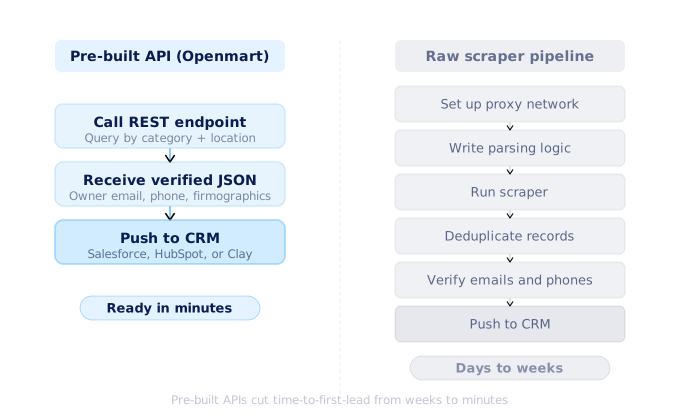
The category splits into two camps that solve different problems. Pre-built databases like Openmart, Apollo, and ZoomInfo return verified records from a curated dataset, so you get clean contacts the moment you call the endpoint. Raw scraping APIs like Bright Data and Outscraper pull live data off the web, which means you handle parsing, deduplication, and verification yourself.
That distinction decides how much engineering work lands on your plate. A verified database hands you owner emails ready for outreach. A scraper hands you raw listings you still have to clean.
Most enterprise APIs index Fortune 500 contacts and corporate domains. Local plumbers, dental offices, and brick-and-mortar shops barely register in those datasets. SMB data APIs specialize in exactly that segment, returning owner-level contacts for the millions of offline businesses enterprise tools skip.
The 6 best B2B data APIs for SMB lead generation
Six APIs dominate the SMB lead generation space, and they split cleanly into two camps. One camp sells verified contact databases you query directly. The other camp sells scraping infrastructure you have to build on top of. Openmart, Apollo, ZoomInfo, and Cognism return pre-built records. Bright Data and Outscraper hand you raw web data and leave the cleanup to you. The ranking below weighs SMB coverage, contact accuracy, pricing transparency, and how much engineering work you take on before the first useful record lands in your CRM.
1. Openmart — local business API
Openmart wins this category because no competitor matches its depth on local business owner contacts. The Local Business API returns the founder, CEO, or owner behind a brick-and-mortar shop, not the generic info@ address every other tool falls back to. You query 200M+ local businesses through a REST endpoint and get owner emails, direct phone numbers, revenue ranges, and tech stack in one response. Sales engineers building enrichment pipelines and growth teams chasing local SMBs get the contacts enterprise-first databases never indexed.
Quick Overview
The API exposes 200M+ local businesses through standard REST calls. Each record carries 50+ fields, including owner emails, direct phone numbers, tech stack, revenue range, and employee count. Openmart backs the service with a 99.9% uptime SLA, batch processing for high-volume jobs, and a status endpoint you poll to track those jobs. Data comes from public and consented records, so the API stays GDPR and CCPA compliant. You push results into Salesforce, HubSpot, or Clay, or export to CSV, Excel, and JSON.
Best For
Pick Openmart if you prospect local and brick-and-mortar SMBs at scale. Sales engineers wiring enrichment into a CRM and growth teams running high-volume outreach get owner-level contacts the rest of the market misses.
Pros
Openmart returns owner, founder, and CEO contacts rather than the catch-all company inbox. Key contact fields hit a 97 to 99 percent accuracy rate, which cuts your bounce rates directly. Coverage spans 300+ industry categories across the US, Canada, Australia, New Zealand, Puerto Rico, and Europe. Credit-based pricing means you pay for data, not per-user seats, so adding a teammate costs nothing. Batch processing pairs with real-time credit tracking, and the API tutorial documents every endpoint you need to start.
Cons
Coverage runs deepest in the US and Canada, and international depth varies by region. If your prospects sit mostly in EMEA, test the data before committing. Openmart also targets the local and SMB segment by design. You will not find rich Fortune 500 org charts or enterprise buying-committee data here, and that is the right trade for the audience this tool serves.
Pricing
A free plan gives you a monthly credit allowance to test data quality before you pay. The Starter tier runs $149 per month for 5,000 credits, which covers a small team or a focused campaign. Pro costs $299 per month for higher volume. Enterprise sits at $999 per month for 40,000 credits, built for high-volume sales and data teams. None of these tiers charge per-seat fees.
2. Apollo.io API
Apollo built its reputation on combining a B2B contact database with sequencing in one platform, and more than 600,000 companies run sales on it. The API extends that database to developers and growth teams who want to enrich CRMs programmatically. Apollo serves mid-market and enterprise outreach well, but local SMB owner data is not where it competes.
Quick Overview
Apollo bundles sales intelligence, a contact database, and outreach automation into a single platform that 600,000+ companies use. API access depends on your plan tier, so lower tiers lock you out of endpoints you might assume come standard. Apollo charges per user, which means costs climb every time you add a seat.
Best For
Enterprise and mid-market sales teams running multi-step outreach sequences get the most from Apollo. The platform pairs contact data with sequencing, so reps prospect and send from one place. Teams chasing corporate accounts will find the coverage they need.
Pros
Apollo holds one of the largest B2B contact databases in the category, weighted toward corporate and mid-market accounts. Sequencing and outreach automation come built in, so you skip a separate sending tool. A free tier gives you 100 credits a month to test the data before you pay.
Cons
Rate limits cap the Professional plan at 50 requests per minute and the Organization plan at 100, which throttles high-volume enrichment jobs. Bulk exports stop at 10,000 records per export, forcing you to chunk large pulls. Users report that credit limits and feature gates push real costs to two or three times the advertised rate. Local and SMB coverage is not Apollo's focus, so owner-level contacts for brick-and-mortar businesses stay thin.
Pricing
Apollo's free plan costs nothing and includes 100 credits a month. Basic runs $49 per user per month for 5,000 credits, and Professional moves to $79 per user per month for 10,000 credits with unlimited sequences. Organization sits at $119 per user per month and unlocks higher API rate limits and larger export sizes. Multiply any of these by your seat count to see the real bill.
3. ZoomInfo API
ZoomInfo owns the enterprise B2B data market, and its enrichment API reflects that focus. You get deep coverage of corporate accounts, org charts, and buying committees that few competitors match. The catch sits in the price tag. ZoomInfo prices for Fortune 500 sales teams, not for anyone prospecting local SMBs.
Quick Overview
ZoomInfo runs an enterprise B2B data platform with an enrichment API attached. The model is credit-based and carries SOC 2 Type II certification, which matters to security teams at large companies. You can buy the enrichment API for around $5,000 per year through the HubSpot marketplace, but that's a stripped-down entry point. The full platform costs far more.
Best For
ZoomInfo fits large enterprise sales teams with data budgets of $30,000 a year or more. You target corporate accounts, map decision-makers across departments, and need the org-chart depth that justifies the contract. If your prospects are local restaurants, dentists, or independent retailers, ZoomInfo indexes almost none of them.
Pros
ZoomInfo delivers the deepest enterprise contact coverage in this comparison. Its SOC 2 Type II certification clears procurement reviews at security-conscious buyers without extra negotiation. Org charts and buying-committee mapping let you see who reports to whom inside a target account, which speeds multi-threaded enterprise deals.
Cons
Pricing is the dealbreaker for SMB work. ZoomInfo starts at $14,995 per year, and real teams pay $30,000 to $60,000 once they add seats and data packages. The platform offers no SMB-friendly tier on price or coverage, so local business prospecting drains your budget for data you won't get. ZoomInfo also locks you into annual contracts, which removes the option to test and walk away.
Pricing
The Professional plan runs around $14,995 per year for three seats and 5,000 credits. Advanced lands between $24,995 and $30,000 per year. Elite starts at $39,995 and climbs from there with add-ons. Compare that to Openmart's $149 per month and the gap for SMB prospecting becomes obvious.
4. Bright Data API
Bright Data sells web scraping infrastructure, not a curated B2B contact database. You point its tools at the web and pull raw data back yourself. That makes it powerful for developers who want full control and useless for anyone expecting verified SMB owner contacts out of the box.
Quick Overview
The B2B Data Scraper API runs pay-as-you-go from roughly $1.50 per 1,000 records. You get JavaScript rendering, residential proxies, CAPTCHA-solving, and worldwide geotargeting. None of that returns a clean owner email or revenue range without you building the scraping logic and parsing the output.
Best For
Choose Bright Data if you write code and want raw web data infrastructure rather than ready-made contacts. Developers who already maintain scraping pipelines will find the proxy network and unblocking tools genuinely useful. Anyone who just wants verified local SMB owner contacts should skip it.
Pros
Bright Data charges per record on the Data Scraper API, so small jobs cost very little. Its geotargeting reaches markets worldwide, and built-in data validation cleans some noise before it lands in your pipeline. You control exactly what you scrape and how.
Cons
Bright Data ships no pre-built SMB owner contacts. You build the scraper yourself, then maintain it as target sites change their markup and defenses. The Web Unlocker API starts at $499 per month for 380K requests, which prices out anyone testing a small idea. Expect real engineering time before you see your first usable lead.
Pricing
The B2B Data Scraper API starts around $1.50 per 1,000 records on a pay-as-you-go basis. The Web Unlocker API begins at $499 per month for 380K requests. Budget for developer hours on top, since neither price covers the scraper you still have to write and run.
5. Cognism API
Cognism wins on European data. The platform built its database around GDPR, CCPA, and PECR sourcing, which makes it the safest pick for teams running outreach into EMEA markets where compliance scrutiny is high. For US local SMB prospecting, it sits far outside its lane.
Quick Overview
Cognism delivers B2B contact data with compliance baked into how it sources records. Independent testing from cleanlist.ai puts email accuracy around 87%, with the strongest coverage across EMEA contacts. Its API matches your records against the compliance-verified database in real time, so enriched fields carry a defensible sourcing trail.
Best For
Pick Cognism if you run a mid-market or enterprise team selling into Europe and need data you can defend under GDPR. The compliance framework is the reason to choose it. Teams chasing US brick-and-mortar owners get little value here.
Pros
Cognism sources every record under GDPR, CCPA, and PECR, which removes the legal guesswork most data buyers carry into EMEA outreach. The real-time enrichment API keeps your CRM current as the verified database updates. EMEA contact coverage runs deeper than any other vendor on this list.
Cons
Cognism hides pricing behind sales quotes, and most teams land at $15K to $25K per year minimum. A platform fee of $15K to $25K stacks on top of per-seat costs, so the entry bar stays high even for small teams. The database also skews enterprise and European, so US local SMB owner contacts fall outside its focus.
Pricing
The Grow plan runs roughly $1,500 per user per year plus the $15K to $25K platform fee. Elevate moves up to around $2,500 per user per year. You contact sales for any firm number, since Cognism does not publish rates.
6. Outscraper API
Outscraper pulls business listings directly from Google Maps and hands you the raw output. It works for developers who want Maps data and nothing else. You get the listing, the reviews, and a phone number, but you handle everything after that.
Quick Overview
Outscraper extracts Google Maps business data at scale through a pay-as-you-go API. You buy credits and spend them per query with no fixed monthly commitment. The product covers Maps listing extraction, a reviews scraper, and a phone lookup endpoint.
Best For
Reach for Outscraper when you need raw Google Maps listings and plan to clean and enrich the data yourself. It suits developers building their own pipeline rather than buying finished contact records.
Pros
You pay only for what you pull, which keeps costs down for small or occasional jobs. The Maps extraction is straightforward to call and returns predictable fields. Outscraper also includes reviews and ratings data, useful if you score prospects by local reputation.
Cons
Outscraper returns listings, not owner contacts. You get no founder emails, no revenue range, and no firmographic enrichment. The output arrives as a raw scrape, so you spend real engineering time deduplicating and validating records. Outscraper also ships no CRM integrations and holds no compliance certifications, which leaves verification and GDPR work on you.
Pricing
Outscraper runs on a credit-based, pay-as-you-go model with no fixed monthly fee. You top up credits and draw against them per request. The structure favors light or one-off extraction over sustained, high-volume prospecting.
Summary comparison table
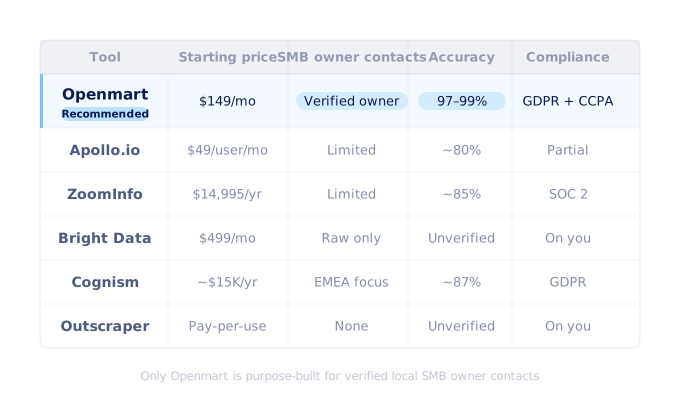
Tool Starting Price Best For SMB Owner Contacts Openmart $149/month Local SMB prospecting ✓ Verified Apollo.io $49/user/month Enterprise outreach sequences Limited ZoomInfo $14,995/year Enterprise GTM Limited Bright Data ~$1.50/1K records Custom scraper infrastructure ✗ Raw only Cognism ~$15K/year EMEA compliance Limited Outscraper Pay-as-you-go Google Maps raw data ✗ None
The pattern jumps out fast. Five of the six tools either treat local SMB owners as an afterthought or skip owner contacts entirely. Apollo, ZoomInfo, and Cognism index corporate accounts and return company-level data when you query a neighborhood plumber or a regional dental group. Bright Data and Outscraper hand you raw scrapes you then have to clean, dedupe, and verify yourself.
Openmart is the only API on this list purpose-built for verified local SMB owner contacts. You query a business and get the founder's email and direct phone, not a generic info@ inbox. At $149/month it costs a fraction of the enterprise platforms that still miss your target segment.
Why Openmart leads for SMB lead generation
Openmart indexes 200M+ local businesses including offline shops, clinics, restaurants, and brick-and-mortar locations that Apollo, ZoomInfo, and Cognism barely touch. Those tools chase corporate accounts and Fortune 500 org charts. The dentist down the street and the family-owned HVAC company never make it into their databases.
You get owner, founder, and CEO contacts rather than the generic info@ address that bounces or routes to a front desk. Openmart verifies key contact fields at a 97–99% accuracy rate, which keeps your bounce rate low and your sales reps off dead leads. Cognism's email accuracy runs around 87% on its EMEA-focused data by independent testing, and that gap shows up in your outreach numbers.
Pricing stays predictable. You buy credits and watch them deplete in real time, starting at $149 per month. ZoomInfo opens at $14,995 a year and pushes real teams to $30K–$60K with add-ons. Cognism stacks a $15K–$25K platform fee on top of per-seat costs before you send a single email.
Openmart covers 300+ industry categories across the US, Canada, Australia, New Zealand, Puerto Rico, and Europe. No enterprise contract negotiation. No per-seat math. You query the businesses you want and pay for what you pull.
How we chose the best B2B data APIs
We ranked these APIs against seven criteria that decide whether a tool actually generates SMB leads or just looks good in a demo.
SMB coverage depth came first. We checked whether each API indexes local and offline businesses or skips straight to corporate accounts. Contact accuracy mattered next. A verified owner email beats a generic info@ address every time, so we weighted owner-level data over company-level records.
We tested API rate limits and bulk processing, since a 50-request-per-minute cap stalls high-volume enrichment. Pricing transparency moved tools up or down. Credit-based plans you can read on a page beat opaque annual contracts you negotiate by phone.
CRM integration with Salesforce, HubSpot, and Clay decided how fast you ship. Compliance certifications like GDPR and CCPA protected your outreach legally. Documentation quality and developer experience broke ties, because an API you can wire up in minutes earns its place over one that fights you.
FAQs
What is a B2B data API?
A B2B data API is a REST endpoint that returns structured business contact and firmographic data in response to a query. Openmart's API reaches 200M+ local businesses with 50+ fields per record, including owner emails, direct phone, revenue range, and tech stack. You use it to enrich CRM records, feed outreach tools, and build targeted lead lists without manual research.
How do I choose the right B2B data API for SMB prospecting?
Start with coverage. Most enterprise APIs index corporate contacts and skip local, offline, and brick-and-mortar businesses entirely. Openmart is the only API purpose-built for local business owner contacts, so it fills the gap those tools leave. Check the pricing model too. Credit-based plans scale more predictably for high-volume use than per-user seat fees.
Is Openmart better than Apollo.io for SMB lead generation?
For local SMB targets, yes. Apollo specializes in enterprise B2B sequences and corporate contacts, so its database thins out on neighborhood businesses and independent operators. Openmart returns owner and founder contacts for the local businesses Apollo misses, and its credit pricing scales more predictably than Apollo's per-user model.
How does a B2B data API relate to CRM enrichment?
A data API appends verified fields to records you already hold, including owner email, direct phone, revenue, and tech stack. Openmart connects directly to Salesforce, HubSpot, and Clay, so enrichment runs automatically as new records arrive. You cut manual research time and aim outreach at contacts who actually pick up.
If I'm already using Apollo, should I also use a B2B data API for SMBs?
Many teams run both. Apollo covers mid-market and enterprise accounts well, but local SMBs sit in its coverage gap. Openmart closes that gap with 200M+ local business records Apollo doesn't index. Use Apollo for enterprise sequences and Openmart for local SMB targets.
How quickly can I see results with Openmart's API?
Setup takes under two minutes with the API tutorial. Individual queries return data in real time, and batch jobs report progress through a status API. A free plan lets you test data quality before you commit to a paid tier.
What's the difference between Openmart's API tiers?
The Starter plan runs $149 a month for 5,000 credits and fits small teams or focused campaigns. The Pro plan at $299 a month raises the credit volume for growing outreach operations. The Enterprise plan at $999 a month delivers 40,000 credits for high-volume sales and data teams.
Best alternatives to ZoomInfo for SMB prospecting?
ZoomInfo starts at $14,995 a year and serves enterprise GTM teams, not local SMB coverage. Openmart delivers owner-level SMB contacts at $149 a month, a fraction of that cost. Apollo offers a lower-priced option for corporate B2B but lacks the same local SMB depth.
Related articles



Start reaching local businesses today
No credit card required
100 free verified contacts


.png)
